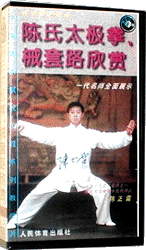
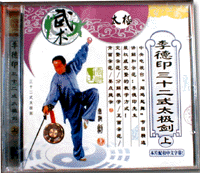
CCTV Television Education Series of of Taiji Quan and Swordplay: Taiji Swordplay Contest Routines
Instructed and demonstrated By Master Men Huifeng
Production by Sports Audio-visual Publication, Beijing
1 NTSC VHS videotape, CHINESE
The sword is called the "gentleman of all weapons." It is the most widely used of all weapons and its influence goes beyond the field of Wushu. Every school of wushu uses the sword as the basic weapon for rigorous training.
Sword play is brisk, agile, elegant, easy, graceful and natural in action. The movements are flexible, as well as variable. Attention is paid to both motion and stillness. Hardness and suppleness supplement each other. So sword play is likened to the "flying phoenix."
There are many techniques in sword play. The main techniques include hitting, piercing, pointing, lifting, jumping and leaping, hanging, chopping, floating, poking, sweeping, wrestling, blocking and wiping. These actions, combined with body movements and footsteps, form various of sword play. There are varied styles of sword play routines, handed down from ancient times. The popular ones include taiji, wudang, bodhi-dharma, longxing, lianhuan, sancai, qingping, baxian, mantis, drunkard and xingyi. The Chinese Physical Culture and Sports Commission has also worked out new routines for competition and physical exercises.
Like taijiquan, taiji swordplay contains both gentle and vigorous movements, proceeding from the principles of "combining vigor and gentleness" and "subduing the hard with the soft." This can be explained from the ancient philosophical view of taiji, which holds that there are two aspects to everything - the positive and the negative.